
Fertilizer Giants Make Farmers and Food Production More Vulnerable
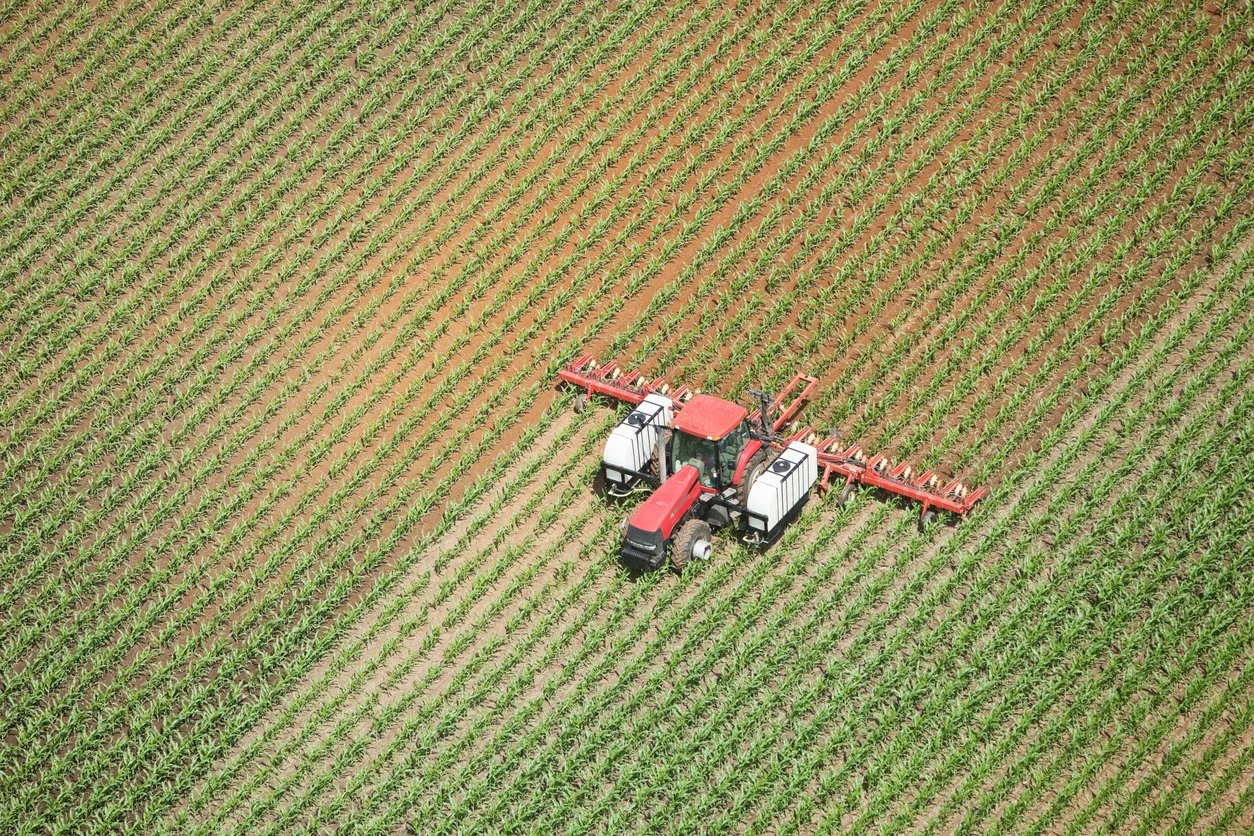
Tractor spreads liquid nitrogen fertilizer. Photo by iStock/BanksPhotos
The U.S.-Israel war with Iran has driven up fertilizer prices by as much as 30% just ahead of spring planting. Fertilizer prices are particularly vulnerable to geopolitical turmoil; they last reached historic levels in 2022 following Russia’s invasion of Ukraine.
Why does war affect fertilizer prices? Part of the reason is practical: non-organic fertilizers are derived from a few specific minerals and fossil fuels, which some regions, such as Middle East, happen to have a lot of. The fuller answer lies in political economy: a few large corporations have rolled up segments of the synthetic fertilizer industry, making production more vulnerable and pricing more volatile. Antitrust enforcement can keep cartels in check and promote more dispersed production, particularly for nitrogen fertilizers, which can now be derived anywhere using renewable energy.
Large-scale, commercial farming runs on synthetic fertilizers. Most fertilizer is made up of three nutrients: nitrogen, phosphorus, and potassium, or “NPK.” Whereas phosphorus and potassium mostly come from mined minerals (phosphate rock and potash, respectively), most nitrogen fertilizer is synthesized from fossil fuels. Production is concentrated in fossil fuel-rich places, such as Russia and the Middle East. Fertilizer production makes up about 1% of all global greenhouse gas emissions each year.
Middle Eastern countries, including Saudi Arabia and Qatar, are major exporters of both phosphate and nitrogen fertilizer components. The U.S.-Israel attacks on Iran have shut down ocean shipping through the Strait of Hormuz, disrupting the flow of approximately one-third of all globally traded fertilizer. Although North America produces a good deal of its own fertilizer, a fertilizer shortage anywhere can spike prices everywhere. Demand is also seasonal. Last year, 25% of U.S. fertilizer imports occurred in March and April as farmers needed fertilizer for spring planting.
Fertilizer prices were already elevated before the war with Iran sent them soaring. The American Farm Bureau Federation and Farm Action sent separate letters to the White House urging action to stabilize fertilizer prices. “Many producers are entering the 2026 growing season facing lower commodity prices, elevated borrowing costs, and persistently high input expenses,” wrote Angela Huffman, president of Farm Action. “Sudden [fertilizer] price spikes can quickly force farmers to scale back applications, reduce planted acreage, or take on additional debt.” For farmers growing corn or wheat, fertilizer makes up 35-40% of their operating costs.
High fertilizer prices will affect global food production and hit poorer countries hardest. Fertilizer supply chain and food trade disruptions following Russia’s invasion of Ukraine drove an estimated 22.3 million additional people into hunger. Regions already experiencing conflict and famine, such as Sudan, Gaza, Yemen, and Mali, are particularly vulnerable.
In theory, nitrogen fertilizer production could be globally dispersed and thus more resilient, but in practice, production is highly consolidated. Four corporations, Koch Industries, Nutrien, CF Industries, and Yara, produce 82% of nitrogen fertilizer in North America. While fossil fuel-based fertilizer production benefits from some economies of scale, these corporations acquired dominant market shares through numerous acquisitions. The two biggest nitrogen fertilizer corporations, CF and Nutrien, are vertically integrated into fertilizer distribution and agricultural retail, posing an additional barrier for competitors to break into the market and reach farmers. Dominant fertilizer corporations also directly own or hold sway over critical fertilizer storage and transport systems.
Consolidation and vertical integration give fertilizer giants the market power to influence prices or exclude competitors. “It’s possible for them to change their rate of production to manipulate or inflate the price,” says Professor Jennifer Clapp, author of Titans of Industrial Agriculture. “There have been longstanding accusations of price manipulation and issues with price volatility in fertilizer.” Dominant fertilizer corporations have a history of shutting down plants and cutting capacity, which helps their bottom line but makes supply chains more vulnerable.
One green energy fertilizer firm, Atlas Agro, wrote in a comment to the USDA that dominant fertilizer companies can leverage their large networks to ramp up production in regions with new entrants to drive down prices and drive out the competition. At the same time, they can profit from higher prices in another, less competitive market, Atlas Agro claims.
Farmers ultimately pay the price. Since 2007, U.S. farmers have paid two to three times more for fertilizer than they did in 2002, and fertilizer giants have made exceptional profit margins. An analysis by economists at Texas A&M found that since 2010, prices for one form of nitrogen fertilizer, anhydrous ammonia, have more closely mirrored changes in corn prices than natural gas prices (the main cost in anhydrous production). “This close correspondence could be due to increased demand for nitrogen products as corn prices increase or could be due to the exercise of market power by nitrogen product manufacturers and extraction of economic rents from corn producers,” the report said.
The Department of Justice is currently investigating phosphate, potash, and nitrogen fertilizer providers for possible antitrust violations. Luke Lindberg, USDA’s undersecretary for trade, told POLITICO that “any company or any part of the fertilizer supply chain who tries to use this opportunity to price-gouge American farmers and ranchers will not be tolerated.”
Policy makers have restructured the fertilizer industry before. Pre-World War II, just two corporations controlled 90% of nitrogen fertilizer production. Antitrust enforcement and public investment helped prop up 17 major U.S. fertilizer producers by 1959, and by 1980, there were 56. Federal financing also supported farmer-owned phosphate cooperatives. Unchecked mergers starting in the 1980s wiped out this competition and reconsolidated the industry.
Periodic global fertilizer shocks encourage farmers and policymakers to imagine what alternative, resilient, and sustainable farming systems could look like. Technology exists to build widely distributed synthetic nitrogen production using renewable energy. One analysis estimated that up to 96% of nitrogen ammonia fertilizer could be competitively produced by decentralized, farm-scale, renewable energy-run systems, owing to savings in transportation and avoided supply chain disruptions.
“If you have better tech, you can produce fertilizer at a smaller scale using renewable energy and have more distributed production,” Clapp says. “That’s a dream a lot of people have, but it doesn’t mitigate nitrous emissions from fertilizer application.” Clapp argues that policymakers should also support agroecological farming practices that help build soil health, so farms are less reliant on synthetic fertilizer in the first place.
What We’re Following
Democratic leader Chuck Schumer introduced a bill to break up meatpacking corporations. It would require meatpacking companies to deal in one line of business, so a corporation like Tyson, which sells chicken, pork, and beef, would need to pick one protein business and divest the other two. The bill would also set market share caps for beef packers, limit exclusive deals between large cattle feedlots and packers, and require foreign-owned corporations to divest their U.S. assets. (Farm Policy News)
The USDA proposed to delay implementation of Biden-era rules that would regulate the controversial tournament system used to pay contract poultry growers. Both the National Farmers Union and American Farm Bureau Federation issued statements opposing this delay. (Press Releases)
The UFCW backed state-level legislation in Minnesota and Iowa banning dominant grocery stores from owning meatpacking plants, a shot at Walmart and Costco’s vertical integration into meatpacking. (Press Release)