
Court Ruling in Kroger-Albertsons No-Hire Case Could Give Employers Immunity to Collude Against Striking Workers
A 2022 strike at King Soopers, owned by Kroger, is at the center of a consequential case that will determine if employers can collude against workers, violating antitrust law, so long as they’re engaged in collective bargaining. Photo by iStock/marekuliasz
While investigating Kroger’s proposed acquisition of Albertsons in 2024, the Federal Trade Commission and the Colorado Attorney General uncovered another probable antitrust violation: an agreement from Albertsons not to hire local Kroger workers during a strike.
Antitrust enforcers successfully blocked Kroger’s takeover of Albertsons, but they’ve struggled to hold the dominant grocers accountable for their alleged no-hire agreement. In fact, an unfavorable federal court decision from February risks undermining worker power by permitting broad employer collusion during a strike. Workers who brought the suit appealed this ruling, and the Colorado AG, along with labor and antitrust advocates, submitted amicus briefs last week in support of reversing the federal court’s decision.
In January 2022, Kroger and Albertsons were both negotiating separate collective bargaining agreements (CBAs) with workers in Colorado represented by UFCW Local 7. While Albertsons agreed to extend its existing CBA with workers at its Safeway stores during negotiations, bargaining stalled with Kroger’s King Soopers, prompting workers to go on a 10-day strike. UFCW Local 7 encouraged striking King Soopers workers to apply for jobs at Safeway, another unionized workplace and one of the only other grocery employers in many Colorado markets. UFCW also encouraged King Soopers workers to shift their prescriptions to Safeway pharmacies, to keep their business with a union grocer and avoid crossing the picket line.
This practice called “whipsawing” is legal and permits unions to play employers off each other and build bargaining leverage during a strike. Maintaining competition between unionized employers can be beneficial to workers in contract negotiations; in fact, the FTC argued that reducing competition for unionized grocery labor and altering collective bargaining dynamics would be a major harm of the Kroger and Albertsons merger.
As it turns out, Kroger and Albertsons did not need to merge to allegedly collude together against union workers. Ahead of the strike, Kroger’s VP for Labor & Associate Relations, Jon McPherson, forwarded UFCW Local 7’s strike guidance to Albertsons VP of Labor Relations, Daniel Dosenbach, asking how Albertsons planned to respond. Dosenbach replied saying, “we don’t intend to hire any King Soupers employees and we have already advised the Safeway division of our position and the division agrees.”
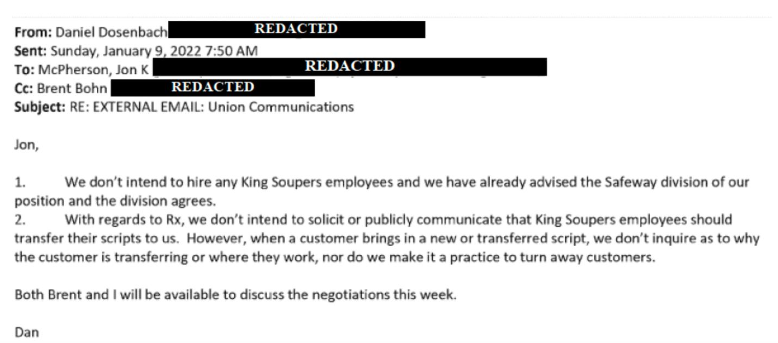
Communication screenshot from workers’ complaint.
The Colorado Attorney General and a class of King Soopers workers both sued Kroger and Albertsons for this apparent no-hire agreement, alleging that it restricted competition for workers and violated antitrust law. The no-hire pact deprived individual workers of the option to seek comparable jobs and undermined their union’s bargaining position. Without the threat that Safeway may hire striking King Soopers workers, Kroger felt less pressure to concede to the union’s demands.
“In a competitive market unmarred by collusion, Albertsons’ Safeway stores—Kroger’s and King Soopers’ primary (and nearly sole) rival in Colorado—would have taken advantage of the strike by hiring away King Soopers workers and soliciting its customers,” workers alleged in their complaint. “The anticompetitive agreement was successful. It artificially reduced the union’s bargaining power during negotiations.”
Workers allege that “the CBAs that were ultimately adopted between Kroger/King Soopers and Local 7 reflected wage scales that were lower than they would have been if the negotiation had taken place in a market that was not tainted by unlawful collusion.”
Despite a clear written commitment from Albertsons to not hire striking Kroger workers, two courts rejected the claims that Kroger and Albertsons violated antitrust law. In the Colorado Attorney General’s case, a Colorado state court judge ruled that the National Labor Relations Board should weigh in on the issue, not state court.
A federal court judge also dismissed Kroger workers’ private case in February, but with a more problematic conclusion. Judge Gordon Gallagher threw out the case on the grounds that a judge-made antitrust exemption insulates the anti-worker conspiracy between Kroger and Albertsons. This decision dramatically expands a narrow antitrust exemption, intended for sectoral bargaining, to effectively permit employers to engage in all kinds of collusive activity. The workers have appealed this decision to the Court of Appeals for the Tenth Circuit.
In the mid-twentieth century, the Supreme Court created a limited “nonstatutory” antitrust exemption to facilitate multiemployer bargaining. The Court recognized that multiemployer bargaining simply would not work if a group of rival employers could not coordinate and agree to a contract that established market-wide standards on wages, hours, and benefits. This exemption is limited to multiemployer bargaining and only permits employer coordination around the core subjects of collective bargaining like wages, benefits, and hours.
In this case, Kroger and Albertsons were engaged in independent, bilateral bargaining with their workers. Accordingly, they did not have to coordinate their negotiations. Even if Kroger and Albertsons had been engaged in multiemployer bargaining, the antitrust exemption would have only allowed them to coordinate in service of the collective bargaining process, not enter a general no-hire agreement. A no-hire agreement is not necessary for multiple employers to engage in contract negotiations.
Nonetheless, because both parties were engaged in union negotiations around the same time, the judge applied this antitrust exemption. In a recently filed an amicus brief, the Open Markets Institute argues that the limited antitrust exemption for multiemployer collective bargaining clearly does not apply to Kroger and Albertsons’s no-poach agreement.
The court’s decision also ignores the larger congressional purpose of both labor laws and antitrust laws: to protect and promote worker power. Labor law allows workers to collectively bargain and protects them from discrimination for organizing or striking. Antitrust law prohibits employers from colluding together to avoid competing for workers. So why would an antitrust exemption, intended to facilitate multiemployer bargaining and further federal labor policy, also permit employers to exercise collusive power against striking workers?
Should this decision stand, it would create a significant loophole for employers to conspire together against workers and undermine unions’ ability to exert economic pressure during a strike. “Expanding the exemption to protect otherwise illegal agreements will incentivize competitors to reach agreements like this in the future,” wrote UFCW Local 7 in their amicus brief. “This goes against the goals of both antitrust enforcement and labor law enforcement and cannot be allowed to stand.”
For now, workers will have to wait for the appellate court’s review. The median wait time for a decision from the Tenth Circuit Court of Appeals is 10 months.
What We’re Reading
Compelling new research reveals the tight social connections between the world’s largest agrochemical firms. (Journal of Agrarian Change)
A new analysis by Food & Water Watch found that global grain trading giants profited handsomely from global food crises: in the five years following 2020 grain trading disruptions, ADM, Bunge, and Louis Dreyfus Company (LDC) nominal profits increased by 61%, 87%, and 86%, respectively. (Food & Water Watch)
The Food & Environment Reporting Network and Mother Jones launched a series on the tensions between the MAHA and MAGA coalitions ahead of the midterms. The first installment profiles Iowa Republican gubernatorial candidate Zach Lahn, who is running on breaking up Big Ag, but previously worked for Koch-funded political projects, raising questions about his commitment to challenge agribusiness power. (FERN)
Between 2010 and 2025, large food corporations launched 239 lawsuits to try and block new public health policies, Lighthouse Reports uncovered. (Lighthouse Reports)
How could lettuce from just one corporation possibly be linked to a national cyclospora outbreak? Farm Action’s new report documents the rise of Taylor Farms and the harms of corporate consolidation in produce production and distribution. The Institute for Agriculture and Trade Policy further explains how food safety and labor deregulation put consumers at risk. (Farm Action and IATP)