
Wall Street Doesn’t Reward Resilience, Main Street Does
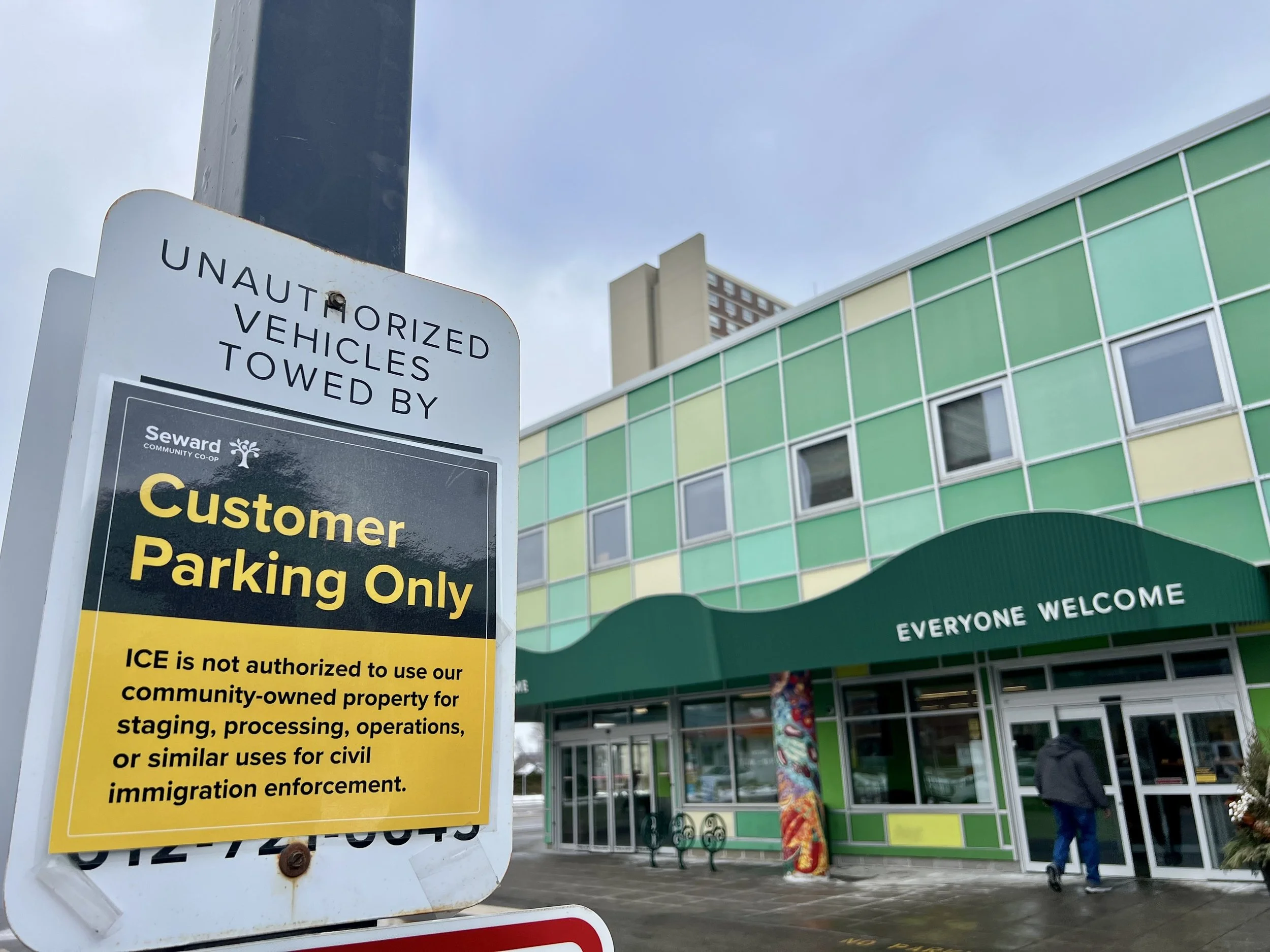
Seward Co-op grocery store restricts ICE use of its parking lot. Photo copyright Claire Kelloway.
Minneapolis, my home, is at the center of the Trump administration’s latest authoritarian escalation. We are witnessing widespread violations of our constitutional rights and a racially-targeted, violent terror campaign against unauthorized immigrants and citizens alike. Federal agents have killed two people in the streets and sent thousands of immigrants into hiding, creating an acute economic crisis for families that must choose between staying together or risking detention just to work, make rent, buy groceries, or go to school.
My neighborhood looks different in subtle ways: there are fewer people on the bus and more people in safety vests at school dismissal. The community center has a new donation table to collect goods for neighbors and offer free hand warmers for observers as well as water bottles with nozzle caps, preferred for flushing chemical irritants out of eyes. It’s widely believed that ICE uses the parking lot at my local Target to stage operations.
We don’t know how long it will take for our communities and economy to recover and feel vibrant and safe for all. The Trump administration announced Wednesday that 700 of the over 3,000 federal agents in Minnesota will soon leave, but Operation Metro Surge will continue. As legal challenges work their way through the courts and Congress debates interventions, Minnesotans are relying on hyper-local organizing to protect each other and our democracy.
This includes bold efforts by small businesses to meet local needs. Minnesota’s powerful corporations, including Target, 3M, United Healthcare, and Cargill, are comparably restrained, absent, or compliant. The stark contrast in business response demonstrates why we need a fair playing field for community-based enterprises to promote local resilience and a healthy democracy.
It is hard to accurately represent or quantify the outpouring of community support from Minnesota small businesses, including restaurants and food businesses. In the Twin Cities alone, restaurants have donated their profits, hosted food donation drop-off sites, fed protestors and mourners, locked their doors and adjusted hours to protect diners and staff, opened their doors to provide warmth and shelter from tear gas for press and demonstrators, and even transformed into emergency field clinics. One of my cherished breakfast spots promised to offer free meals and run entirely off donations until federal agents leave Minneapolis. Statewide, over 700 businesses participated in an economic blackout on January 23.
Local businesses have raised hundreds of thousands of dollars and shifted operations to meet people’s immediate needs, even as they too struggle to make rent. Small businesses have been hit hard as workers and shoppers stay home for fear of Immigration and Customs Enforcement (ICE). Lake Street is a six-mile business corridor in Minneapolis with an estimated 2,000 restaurants and shops, many owned by immigrants. Marie Campos, marketing manager for the Lake Street Council, told CNBC that Lake Street businesses are struggling with anywhere from 40% to 100% fewer sales compared to last winter.
“I'm using the money for rent to help my staff, because that's what we need to do,” Pedro Wolcott, owner of the recently opened hockey-themed sandwich shop, North Star Deli, told Mpls.St.Paul.Magazine. “I want to make sure those kids are eating and families are okay.”
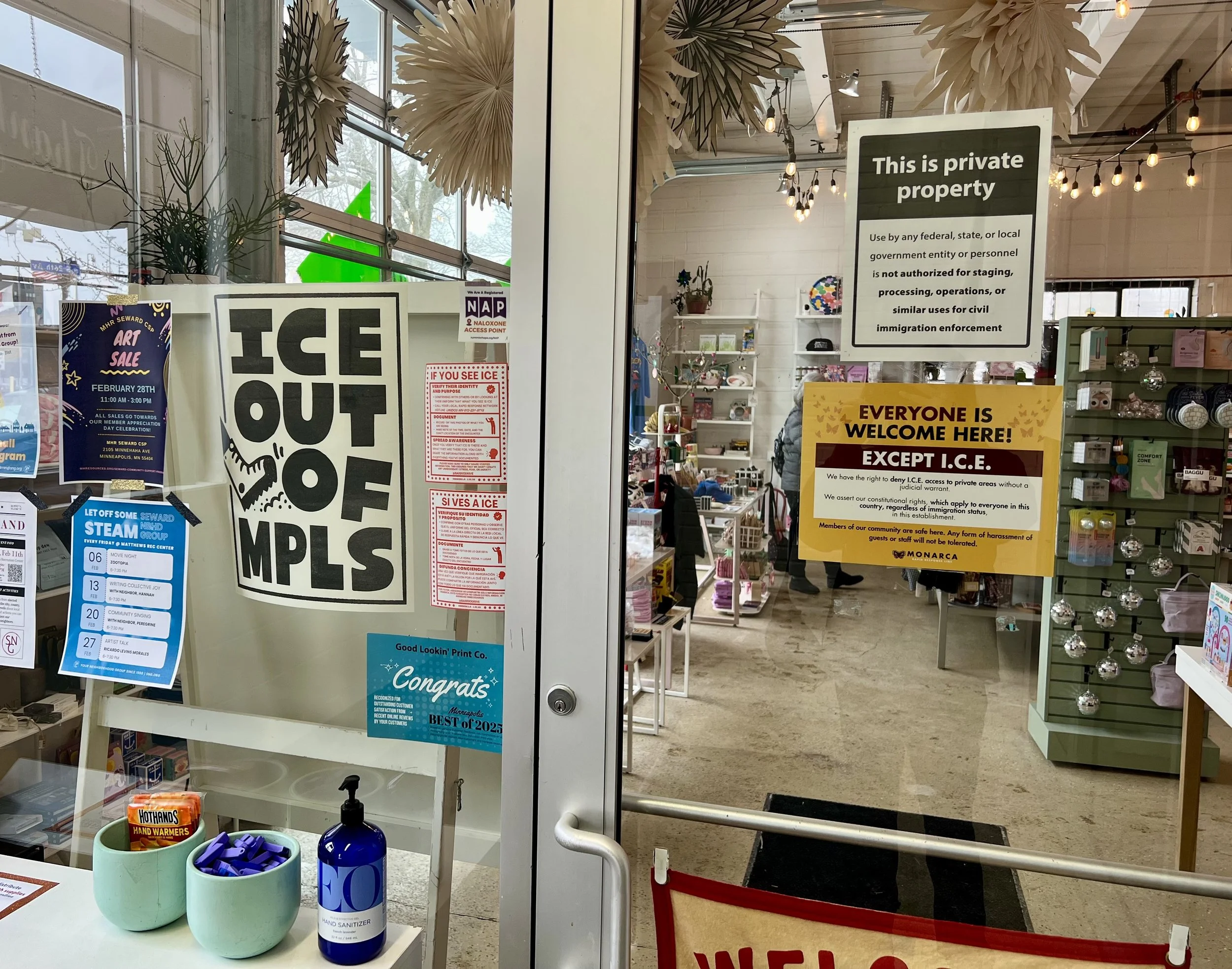
Bench Pressed gift shop and printing press in Minneapolis offers hand warmers, whistles, and know your rights resources. Photo copyright of Claire Kelloway.
By contrast, large corporations have done relatively little to help residents or challenge the Trump administration. Corporations with headquarters in Minnesota, such as Target, 3M, United Health Care, General Mills, and Best Buy, turned down media requests for comment on Operation Metro Surge for weeks until ICE agents shot and killed V.A. nurse Alex Pretti on January 24. The next day, more than 60 CEOs of Minnesota-based corporations released a tepid letter calling for “an immediate deescalation of tensions.” It said CEOs were working “behind the scenes” and communicating with “the Governor, the White House, the Vice President and local mayors” to try and “advance real solutions.”
The letter does not name ICE nor call for specific actions. When Popular Information asked all 68 signatory companies if they condemned the killings of two Minnesotans by federal officers, every single one either declined to comment or did not respond. We know that these corporations can take a more explicit stance because in 2020, dozens of them publicly condemned Minneapolis police for killing George Floyd.
When it comes to charitable contributions, 28 Minnesota corporations, including Blue Cross Blue Shield, Target, Ecolab, General Mills, U.S. Bank, and Xcel Energy, donated a combined $3.5 million through the Minneapolis Foundation to fund grants for small businesses disrupted by Operation Metro Surge. While $3.5 million is nothing to sneeze at, it pales in comparison to the $50 million the Minneapolis Foundation raised from corporations following Floyd’s murder. And compared to the sacrifice of many local small businesses, a combined $3.5 million is peanuts for corporations making billions in net income.
As The American Prospect notes, several of the same corporations now calling for deescalation publicly supported or actively lobbied for Trump’s Big Beautiful Bill (OBBA), which laid the groundwork for federal incursion by nearly tripling ICE funding. 3M gave a quote to the White House’s OBBA endorsement list. 17 of the corporations whose CEOs signed last week’s letter reported direct lobbying on the OBBA in their federal lobbying disclosures, and CEOs for Hormel, Land O’ Lakes, Allianz, Best Buy, C.H. Robinson, Medtronic, Boston Scientific, and Target serve on trade associations that lobbied for the OBBA.
Protesters have singled out Target for permitting ICE agents to stage in their parking lots and use their restrooms. Activists want Target to demand that ICE leave Minnesota and deny federal agents access to their facilities (though some lawyers doubt that Target can bar ICE from semi-public spaces like parking lots).
CNN reported that Minnesota corporate leaders fear backlash from conservatives who support mass deportation, as seen in the pile-on against Hilton after a Minnesota franchise allegedly refused to house ICE agents. Greater still, they fear retaliation from the Trump administration for challenging its actions.
The governance structures and incentives of concentrated corporate giants reward maximizing profits and maintaining cozy relationships with federal leaders, no matter the social cost. This would not be the first time that a fascist government brought consolidated corporations to heel in service of its totalitarian project.
Smaller businesses have more autonomy and flexibility to react quickly to a crisis. They also have a greater incentive to support their communities, not just because they live and work within them, but also because a good reputation can pay dividends in the long run. Sadly, it is harder than ever for small businesses to thrive and grow in America’s increasingly monopolized economy.
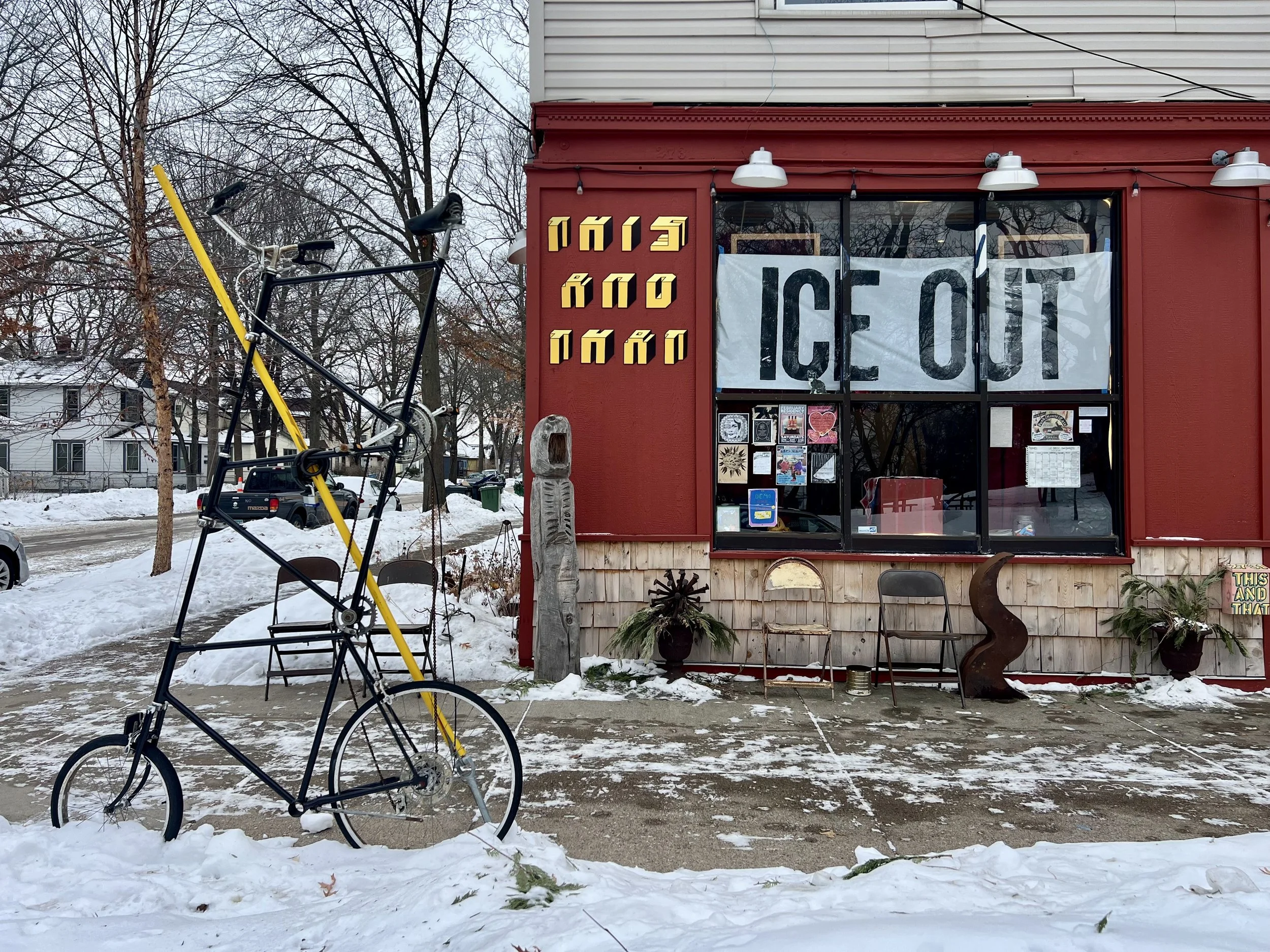
An art studio in south Minneapolis. Photo copyright Claire Kelloway.
What We’re Reading
You can read more on corporate cowardice and complicity in Minnesota in The American Prospect, the Minnesota Reformer, and You’re Probably Getting Screwed newsletter.
SNAP participation declined by 1.75 million people during President Trump’s first year in office. The administration says this is a sign of economic strength, while hunger advocates worry that it reflects higher barriers to benefits. (Civil Eats)
The Institute for Local Self-Reliance published a policy brief and interactive map demonstrating the connection between grocery consolidation and food deserts. (ILSR)